Greg McKeown:
Hello, everybody. I am your host, Greg McKeown, and I am coming to you now, for the first time in quite a while, with a solo episode, to be able to share with you a marvelous milestone. We have reached ten years since the publication of Essentialism, a decade of Essentialism, in fact. Just think of all that has happened in the last ten years. Think of all that it means, and think of how wonderful the next ten years can be, the next decade of Essentialism can be in your life. If you can pursue those things that matter most, if you can eliminate the non-essentials, if you can make it as effortless as possible to do what’s essential, and to do that in an ongoing, disciplined way, it seems to me that that is worth pursuing, that that is the recipe for developing, designing, and then delivering a life that really matters. Let’s get to it.
Something I want to add, something I don’t want you to miss, is that this podcast is now, right now, ad-free. And the goal is to make it ad-free forever. And that is such an exciting thing to me. Maybe it doesn’t seem like a big deal to you. But it’s an advantage. It’s something that you’re happy to have, to not navigate that. But it’s so clear and simple to me that this is how it should be. In hindsight, I wonder whether really it should always have been ad-free. But c’est la vie—now we’re here, and we don’t want to continue doing something just because we did it before.
And I hope that as we continue ad-free, you will consider being able to be part of the whole ecosystem that I’ve spent the last ten years building, bit by bit, brick by brick, to be able to help you. I’m thinking here now of the Essentialism Academy at essentialism.com, which has high-quality videos—like a masterclass level of videos. More to be announced about that coming soon. I hope that you’ll consider utilizing the show notes that are being designed specifically for every episode of this, not just with the links and references that we discuss.
That’s something that’s useful, but also specific questions, reflections, and summaries so that you can go a little below the surface of these conversations. If you haven’t already, I hope you’ll take advantage of the free Less but Better Workbook and 30-day email course. It’s completely free. You just go to gregmckeown.com, and it’s right there on the homepage. Scroll down just a little ways, and it’s right there. You can sign up in 10 seconds or less, and you’ll be able to get a kind of course that would normally, certainly cost money.
It answers the simplest questions, which is, where do you start in your essentialism and effortless journey? What’s the beginning? And that’s what that course is all about, the Less but Better course. I hope that you’ll be able to tap into that and utilize that.
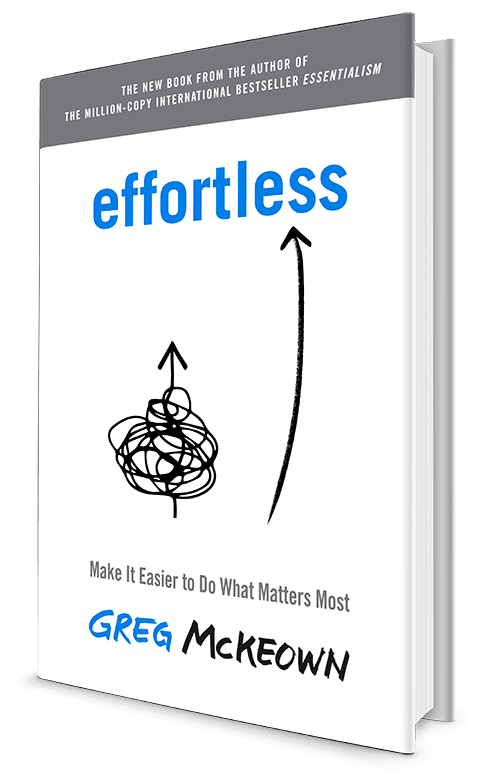
If you haven’t read Effortless yet, I hope that you’ll take the time to do it and involve other people in it. Because I think the paradigm shift within Effortless is as great as anything in Essentialism. Because for insecure overachievers like me—and perhaps I’m not alone—we need a guide to healthy productivity to be able to operate in what actually is an optimal way. It doesn’t just keep us from burning out, which is not nothing, but it also helps us to actually accomplish more. So it’s not about being lazy, but it’s about having a much higher return on the effort that you do put in. These are pieces of a growing ecosystem to be able to help you in your journey to actually live a life that really matters.
So we’re ad-free here, but I hope that, in a sense, the exchange becomes that you will support what we’re doing in a way that actually helps you to implement these ideas.
So now, ten years, we have the 10th anniversary edition of Essentialism that is out. It’s going bananas, I actually have to say. It’s growing. It’s reaching ever more people, and, well, it makes me reflect on some of the people that we’ve had on the podcast.
It makes me think of some of the people who have reached out to me over the years. For example, a few years ago, Banks Benitez, who was then the CEO of Uncharted, which is a Denver-based social impact firm, found himself entangled in the all-too-familiar web of endless workdays. His life was a blur of meetings, emails, and a relentless pursuit of more. And then, one day, he stumbled upon the book Essentialism.
And embracing that philosophy wasn’t just a minor adjustment for Benitez. It provoked a radical overhaul of his entire approach to work and life. He started by scrutinizing every task, meeting, and email, asking that critical question, “Is this absolutely essential?” It was more than just time management. It was a quest for meaning, for impact. And by shedding the non-essential, Benitez reclaimed his time and purpose.
The transformation was profound and personal. But Benitez didn’t stop there. He envisioned a broad application of Essentialism within Uncharted. His idea was revolutionary yet simple. Achieve more by doing less. Benitez then went beyond it. He spearheaded a bold experiment to transition Uncharted, the company itself, to a four-day workweek without sacrificing productivity or financial performance. His challenge to the status quo of the traditional workweek was met—let’s say it this way—with skepticism.
But the results spoke volumes. Productivity soared, employee satisfaction hit an all-time high, and the company’s performance strengthened. Uncharted became a beacon of the four-day workweek movement, proving that when we focus on what truly matters, less can indeed be more. I just love that story and many, many others like it that have been shared with me as I’ve traveled all over the world, as I’ve worked with people everywhere.
I mean, Essentialism arrived in bookstores in April 2014, and I could never have fathomed the impact it would have on people like Banks in the decade that’s followed. His story illustrates how one person’s quest for a more meaningful life can go beyond that and spark a movement that challenges conventional wisdom and reshapes entire organizations. Every day, someone sends me a note to say how reading Essentialism changed their life, and that does not grow old.
People don’t just read the book; they seem to experience it. People don’t just read the book cover to cover once, either. They make it an annual tradition. One Hollywood agent told me he had read or listened to the book 17 times, but it wasn’t just that. He had also transformed his portfolio of clients as a result and had sold his condo in LA and moved out to a place where he could raise his family in relative peace.
Seeing Essentialism become a part of the wider culture has been humbling, of course, and thrilling, too. Kanye West declared himself an essentialist in a conversation with Joe Rogan. It’s Steve Harvey’s favorite book. Former First Lady of California Maria Shriver shares insights from the book in her coveted Sunday luncheons. Even presidential hopefuls have voiced their allegiance to its transformative power.
In Brazil, Essentialism has been outselling Harry Potter. In Japan, there’s a series of graphic novels based on its ideas. People from over 100 countries now take online classes. My 1-Minute Wednesday newsletter has expanded everywhere. This podcast has grown into a living conversation with people the world over. And Essentialism has changed my own life, too. In the decades since Essentialism was published, I’ve given keynotes to hundreds of organizations across more than 45 countries.
And naturally, I’ve said no much, much more than I’ve said yes. Those engagements represent less than 10% of the requests I’ve received. And all this while my family, the priority in my life, has thrived. Anna and I have grown ever closer. Our children are our closest friends. The trade-offs have been deliberate, intentional, and worth it. The number of invitations that have been made to me is so overwhelming. I’ve had to become an essentialist in new ways myself.
I feel like Ann Morrow Lindbergh, who wrote in Gift from the Sea, “My life cannot implement in action the demands of all the people to whom my heart responds.” Anna shared that with me years ago, but it’s something that has come back to me repeatedly over these last ten years. The world has also changed. In the decade since Essentialism was first released, it’s only grown more cluttered with mind-bending technology, becoming even more powerful and more distracting.
As I think about this now, in this moment, I think the principles of Essentialism strike me as not only still more relevant, but more crucial than ever for navigating today’s relentless tide of demands. Though Essentialism has sold millions of copies around the world, its work is far from over. I want a new generation of readers and listeners to embrace the power of less, to focus on what truly matters, and reclaim the essence of a life lived with intentionality and purpose in a world that champions more.
This book stands as a defiant counter-narrative, advocating for the liberating clarity that comes from choosing less but better. Each year, the Essentialism community grows, reaching more readers today than yesterday, more yesterday than the day before. Ten years on, and our journey, fellow essentialists, has only just begun. To me, a book is so much more than paper and ink. A book is a portal. It can take a reader, a listener to places and times they have never been.
I wonder, where will Essentialism take you? Thank you. Really, thank you for listening.